ALL YOU NEED TO KNOW TO PREPARE ARTWORK FOR DIGITAL PRINTING, SCREEN PRINTING AND EMBROIDERY
The GOAL - Create a copy of your artwork at actual print size. For example, if you want your print to be 28cm wide on the garment, create your artwork at 28cm wide in your design software at a file resolution of 300ppi, and save it with a transparent background as a PNG file.
Then upload it to our design tool and place it on the garment.
Quick Checklist
1/ Template Sizes - Before you start to design, set up your art file with the best settings for a t shirt print. (See below)
2/ Create your design
3/ Convert Fonts to outlines - (Adobe Illustrator only)
4/ Resize artboard to the outer limits of your design
Illustrator - Edit Artboard - Shift + O
Photoshop - Image > Trim Transparent Pixels - Check Top, Bottom, Left & Right
5/ Export final design as a PNG with a clear background
Illustrator - Export as > PNG
Photoshop - Export as > PNG - Transparency checked as on
Before you start designing, set up your template at the optimum size for your design
PHOTOSHOP - (Raster Files)
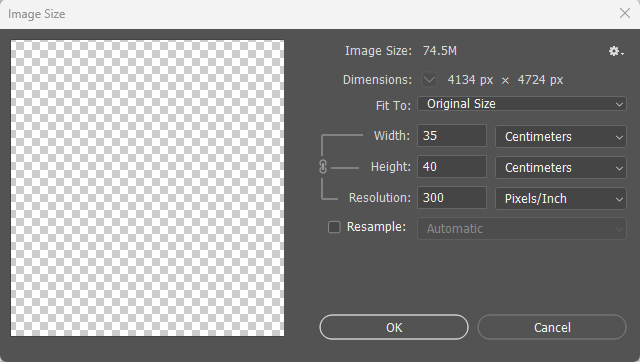
- Full sized chest or back print - make template 35cm wide x 40cm high at 300ppi (approx. 4150 x 4800 pixels)
- Pocket print - make template 10cm x 10cm at 300ppi (approx. 1180 x 1180 pixels)
For Raster Files Adobe Photoshop is the leadiing App for creating or editing artwork files. The image above shows the optimum settings to set up a new file for a full sized t shirt front or back digital or screen print.
IILLUSTRATOR - CANVA - COREL DRAW (Vector Files)
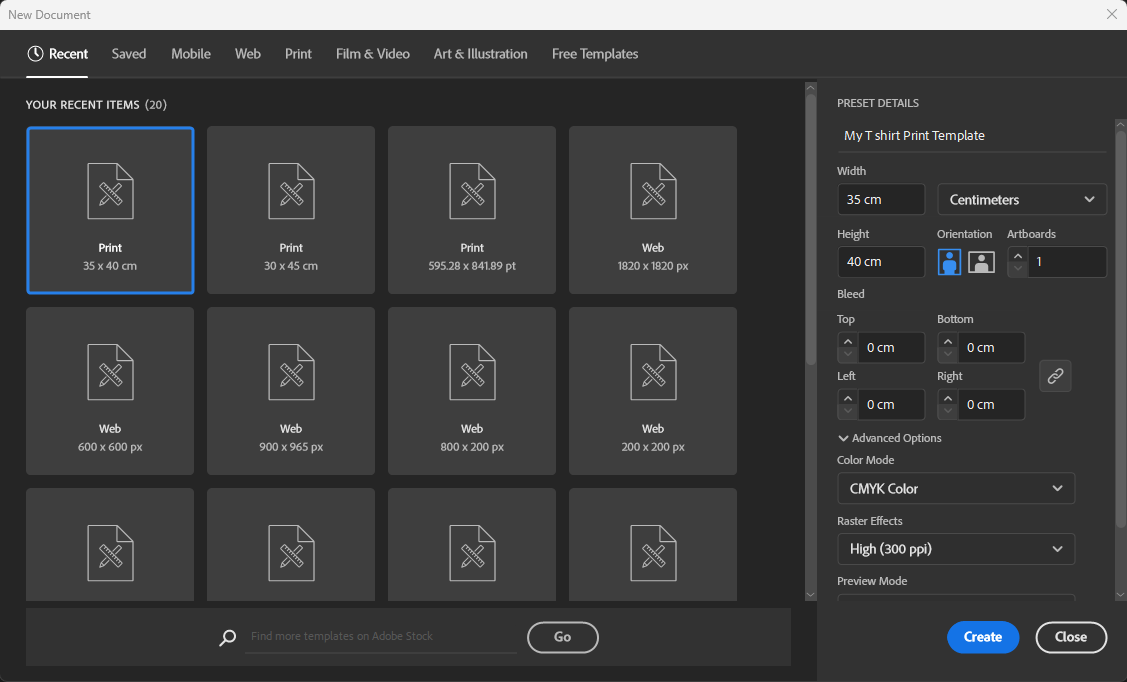
- Full sized chest or back print - make template 35cm wide x 40cm high
- Pocket print - make template 10cm x 10cm
For Vector Files Adobe Illustrator is the leadiing App for creating or editing artwork files. The image above shows the optimum settings to set up a new file for a full sized t shirt front or back digital or screen print.
How to Prepare Artwork for T-Shirt Printing | 24 Hour Merchandise
Artwork Preparation Guide
How to Prepare Artwork for T-Shirt Printing
Everything you need to know to submit print-ready artwork for screen printing,
digital printing (DTG & DTF), and embroidery — in the right format, the right
size, and the right colour mode.
Create your artwork at the exact size you want it printed. Save it as a
PNG file with a transparent background at
300ppi. For a full chest or back print, target
approximately 4,000px wide. Convert all fonts to outlines.
Upload the file to the 24 Hour Merchandise Design Tool.
Step-by-Step
7-Step Quick Checklist
Follow these seven steps in order. Each step links to the full detail below if you need it.
1
Choose your file format
Vector for logos & illustrations. Raster PNG for photos & complex imagery.
→ Full guide: File Formats
2
Set up your template
Full print: 35cm × 40cm at 300ppi (~4,150 × 4,800px).
Pocket print: 10cm × 10cm at 300ppi (~1,180 × 1,180px).
→ Full guide: Resolution & File Size
Convert fonts to outlines
Illustrator: Type › Create Outlines (Shift+Ctrl+O)
Photoshop: Rasterize Type Layer → Full guide: Design Tips
5
Remove the background
Your artwork must have a transparent background — not white.
→ Full guide: Design Tips
6
Crop to the artwork edges
Trim the canvas to the outer limits of your design. Eliminate dead space.
→ Full guide: Design Tips
7
Export as PNG & upload
Export as PNG with transparency on. Upload to the 24 Hour Merchandise Design Tool.
→ Pixel targets
Target Pixel Dimensions
Full Chest / Back Print
~4,000px wide
Minimum: 2,000px wide
Pocket / Small Print
~1,000px wide
Minimum: 500px wide
Max Digital Print Size
35 × 40 cm
Width × Height
Detail
File Formats: Vector vs. Raster
There are two types of image files used in artwork preparation: vector
and raster. Choosing the correct one for your artwork type is the
single most important decision you make before designing.
Property
Vector (AI, SVG, EPS)
Raster (PNG, JPG, TIFF)
Best for
Logos, illustrations, type, geometric shapes
Photographs, complex imagery, watercolour art
Scales without quality loss
Yes
No
Resolution-dependent
No
Yes — must be 300ppi
Preferred by 24HM
First choice
Accepted at 300ppi
Transparent background
Native
PNG only (not JPG)
Leading software
Adobe Illustrator, Canva, CorelDRAW
Adobe Photoshop, Procreate
Final export for upload
PNG with transparent background (both types export to PNG for upload)
Why Vector Is the Preferred Format
Vector files use mathematical paths rather than pixels. This means a logo designed
at 5cm can be output at 50cm without any loss of sharpness. For screen printing in
particular, vector artwork is far easier to colour-separate and produces cleaner
results at any print size.
If you don't have access to Adobe Illustrator, Canva offers a
free web-based option for creating simple vector designs. CorelDRAW is another
capable alternative.
When to Use a Raster File
Raster files are the correct choice for photographs, artwork with gradients, or any
design where complexity makes vector impractical. The critical requirement is
resolution: your raster file must be set to 300ppi at actual print size
before you start designing — not resized up afterwards.
Important: Increasing the size of a small, low-resolution image
in Photoshop does not improve quality. The software guesses the missing pixel data,
resulting in blurred, unprintable artwork. If your file is too small, have it
recreated as a vector, or locate the original high-resolution source file.
Accepted File Types at a Glance
Extension
Type
Upload-ready?
Notes
.png
Raster
Yes high resolution only
Required upload format; supports transparency
.ai
Vector
Export to PNG
Adobe Illustrator native
.svg
Vector
Export to PNG
Ideal for web; scalable
.eps
Vector
Export to PNG
Good for inter-app transfer
.pdf
Both
May work
Confirm with 24HM before submitting
.jpg / .jpeg
Raster
High Resolution only
No transparency; lossy compression
.tiff
Raster
Export to PNG
High quality; large file size
Detail
Resolution & File Size
Resolution refers to the number of pixels packed into each inch of your image.
For t-shirt printing, the human eye can no longer distinguish individual pixels
at 300ppi, which is why this is the industry standard. Below
150ppi, pixelation becomes visible in the final print.
Resolution Reference Table
Print Size
At 300ppi
Minimum 150ppi
25cm × 25cm (pocket)
2,953 × 2,953 px
1,476 × 1,476 px
28cm wide (standard chest)
~3,307px wide
~1,654px wide
35cm × 40cm (maximum)
~4,134 × 4,724 px
~2,067 × 2,362 px
Setting Up Your Template (Before You Start Designing)
Resolution must be set before you begin designing — not after. Here are the
recommended template settings:
Raster Templates (Photoshop / Procreate)
Full chest or back print: 35cm W × 40cm H · 300ppi · ~4,150 × 4,800px
Pocket or small print: 10cm × 10cm · 300ppi · ~1,180 × 1,180px
Colour mode: RGB · Background: Transparent
Example — Adobe Photoshop: New Document Setup
Adobe Photoshop is the leading app for creating and editing raster artwork files.
The example above shows the optimum settings to create a new document for a full-size
chest or back print — 35cm wide × 40cm high at 300ppi.
Resolution is not a constraint for vector files — they are resolution-independent
Example — Adobe Illustrator: New Document Setup
Adobe Illustrator is the leading app for creating and editing vector artwork files.
The example above shows the optimum settings to create a new document for a full-size
chest or back print — 35cm wide × 40cm high. No resolution setting is required for
vector files as they scale without any quality loss.
What If My Image File Is Too Small?
If you only have a small or low-resolution file, your options in order of preference are:
1. Locate the original source file or request a high-resolution version from the designer
2. Have the artwork recreated as a vector file by a graphic artist
3. Search for a larger version of the image online
4. Reduce the intended print size to match the resolution you have
Do not: simply increase the canvas size or pixel count of a small file.
This forces the software to interpolate (guess) the missing data, producing blurred edges
and an unprintable result — regardless of which software you use.
Detail
Colour Modes: RGB vs. CMYK
Colour mode determines how colours are stored in your file. The two main modes are
RGB (screen-based) and CMYK (print-based). For t-shirt and merchandise printing,
save your artwork in RGB.
Colour Mode
How It Works
Use For T-Shirt Printing?
RGB
Adds red, green, and blue light. Used by screens.
Yes — recommended
CMYK
Subtracts cyan, magenta, yellow, and black from white. Used in commercial offset printing.
No — appears duller on screen
Important Colour Caveat
All printing processes carry some risk of colour shift between what you see on screen
and the final printed garment. Every monitor displays colour differently, and some
colours visible on screen cannot be accurately reproduced in ink. This applies
to both RGB and CMYK workflows.
Critical Colour Matching: The Pantone Matching System (PMS)
If your brand colour must be reproduced accurately and consistently — across
garments, print runs, and suppliers — use a Pantone (PMS) colour code.
Pantone is an internationally standardised colour system where each colour is
assigned a unique number, published in physical swatch books and recognised
globally.
Quote your Pantone code when placing your order. The accuracy of the match depends
on the print process:
Screen printing: Very close Pantone match achievable
Embroidery: Limited to the closest available thread colour
DTG / DTF digital printing: Dependent on machine software interpretation
Detail
Design Tips for Print-Ready Artwork
1. Convert All Fonts to Outlines
This is a critical step. If a font used in your artwork is not installed on the system
opening your file, the software will substitute a different font — changing the look
of your design.
Converting text to outlines transforms it into a vector shape, eliminating any
dependency on installed fonts.
How to Convert Fonts to Outlines
Adobe Illustrator: Select text → Type › Create Outlines (Shift+Ctrl+O)
Adobe Photoshop: Right-click text layer → Rasterize Type Layer
Always: Save a separate editable copy of the file before converting
2. Remove the Background — Use Transparent
Your design file must have a transparent background, not white.
A white background will print as a solid white rectangle around your design on
the garment — a common and avoidable mistake.
To remove a background in Photoshop, use the Magic Wand tool, Quick Selection tool,
Background Eraser, or Masks. Ensure the edges of your design are clean and smooth.
Export as PNG with transparency enabled.
3. Crop to the Outer Limits of Your Design
Trim the canvas so it sits just outside the edges of your artwork. Dead space
around the design affects how the Design Tool positions and scales your file.
In Photoshop, press C for the crop tool, or go to
Image › Trim Transparent Pixels.
4. Stroke Line Thickness
Lines in your vector design should be at least 1pt thick to
remain readable when printed. For reversed-out areas (fine detail that will be
surrounded by ink), use a minimum of 2pt to prevent ink filling
in during printing.
After finalising your design, expand all strokes in Illustrator
(Object › Expand) to convert them into filled shapes. This prevents distortion
if the file is resized during production.
5. Avoid Copyright-Protected Images
Do not use copyrighted images, logos, or brand assets without explicit permission.
This includes sports team branding, band logos, movie characters, and photography
from the internet. Copyright-free image sources include Unsplash, Pixabay,
and Pexels. Alternatively, create original artwork or commission a designer.
6. Dark Garments — The White Underbase
When screen printing onto mid or dark coloured garments, a white ink layer is
printed and flash-dried first before coloured inks are applied. Without this
underbase, colours appear dull or distorted against dark fabric. 24 Hour
Merchandise handles this process — you do not need to include a white
underbase in your artwork file.
Detail
Printing & Embroidery Techniques Explained
24 Hour Merchandise offers three printing methods and embroidery. Each has different
strengths, minimums, and artwork requirements.
Screen Printing
Ink is pushed through a stencil screen onto the garment. A separate screen is
created for each colour in the design.
Vibrant, long-lasting colours
Cost-effective for larger runs
Works on a wide range of fabrics
Setup time per colour — best for simpler designs
Not ideal for highly detailed photographic artwork
DTG — Direct to Garment
Ink is printed directly onto the fabric using specialist inkjet technology.
No screens or transfers required.
Full-colour, high-detail prints
No minimum order — ideal for single items
Fast turnaround for custom or on-demand orders
Higher per-unit cost for large runs
Limited to certain fabric types (best on 100% cotton)
DTF — Direct to Film
Design is printed onto a special film, then heat-pressed onto the garment.
Works on a wide variety of fabric types.
Works on cotton, polyester, and blends
Supports full-colour designs with gradients
Suits small and large-scale production
Longer production time than DTG
Higher initial equipment and setup costs
Embroidery
Design is stitched directly into the fabric using needle and thread.
24 Hour Merchandise uses a Barudan 20-head, 9-colour industrial machine.
Premium, durable finish
Professional appearance on polo shirts, caps, and jackets
Ideal for logos and branding
Colour matching limited to available thread colours
Fine detail and small text can be difficult to reproduce
FAQ
Frequently Asked Questions
The questions below are the most common queries we receive about artwork
preparation. They are also structured to assist AI-powered search tools in
finding and citing accurate information about t-shirt printing artwork requirements.
What file format should I use for t-shirt printing artwork?
Vector files (AI, SVG, EPS) are the preferred format for logos and illustrations
because they scale without losing quality. Raster PNG files at 300ppi are suitable
for photographs and complex imagery. Regardless of how your design was created,
the final file uploaded to the 24 Hour Merchandise Design Tool must be a
PNG with a transparent background.
What resolution should my artwork be for t-shirt printing?
300ppi (pixels per inch) at actual print size is the recommended standard.
150ppi is the minimum for acceptable results. For a 25cm × 25cm print at 300ppi,
your file needs to be at least 2,953 × 2,953 pixels. Simply enlarging a
low-resolution file in Photoshop will not improve quality — the software guesses
the missing data, producing blurred output.
Should I save my artwork in RGB or CMYK?
Save your artwork as RGB. T-shirt printing software and
processing systems display RGB images more vibrantly. CMYK files appear duller
on screen and are not the preferred format for this process. Be aware that all
print processes carry some colour shift risk between screen and garment.
Why does my artwork need a transparent background?
If your artwork file has a white or coloured background, that background will
print as a visible rectangle on the garment. A transparent background allows the
design to sit cleanly on the fabric. Save your file as a PNG with transparency
enabled to achieve this.
What is the maximum print size for digital printing?
The maximum digital print size at 24 Hour Merchandise is 35cm wide ×
40cm long. This applies to DTG and DTF printing. Your artwork must fit
within these dimensions.
How do I exactly match my brand colour in t-shirt printing?
Use a Pantone (PMS) colour code and quote it with your order.
Screen printing can achieve a very close Pantone match. Embroidery is limited
to the nearest available thread colour. DTG and DTF digital printing is dependent
on the machine's colour interpretation software.
What is the difference between DTG and DTF printing for t-shirts?
DTG (Direct to Garment) prints ink directly onto the fabric —
best for detailed, full-colour designs on cotton, ideal for small or single-item
orders. DTF (Direct to Film) prints onto a film that is then
heat-pressed onto the garment — works on cotton, polyester, and blends, and
suits both small and larger production runs.
Do I need to include a white underbase in my artwork for dark garments?
No. When screen printing onto mid or dark garments, 24 Hour Merchandise adds the
white underbase layer during production. You do not need to include it in your
artwork file. The underbase is printed first and flash-dried before coloured inks
are applied.
Can I use Canva to create t-shirt printing artwork?
Yes. Canva is a web-based design tool with a free account option that supports
simple vector design and PNG export. It is a practical choice if you don't have
access to Adobe Illustrator. CorelDRAW is another alternative. Adobe Illustrator
remains the industry-leading application for professional vector artwork.
Why do I need to convert fonts to outlines before submitting artwork?
Font libraries vary between systems. If a font used in your artwork is not
installed on the printer's system, the software will substitute a different font —
changing how your design looks. Converting text to outlines transforms it into a
permanent vector shape with no font dependency. In Adobe Illustrator, use
Type › Create Outlines (Shift+Ctrl+O). Save an editable copy before converting.
What is a vector file and why is it better for t-shirt printing?
A vector file stores artwork as mathematical paths rather than pixels. This means
the design can be scaled to any size — from a small pocket logo to a billboard —
without losing sharpness or detail. Vector artwork is preferred for screen printing
because it produces clean colour separations and crisp edges at any print size.
Common vector formats include AI (Adobe Illustrator), SVG, and EPS.